Starting today I will begin posting my trip on my blog as I find Facebook to be too unwieldy. I'll always post a link to the blog and hope it works. I'd appreciate hearing from someone to make sure the link is working.
Monday, November 12, 2018


Saturday, March 25, 2017
Love Urgently, Live Brilliantly
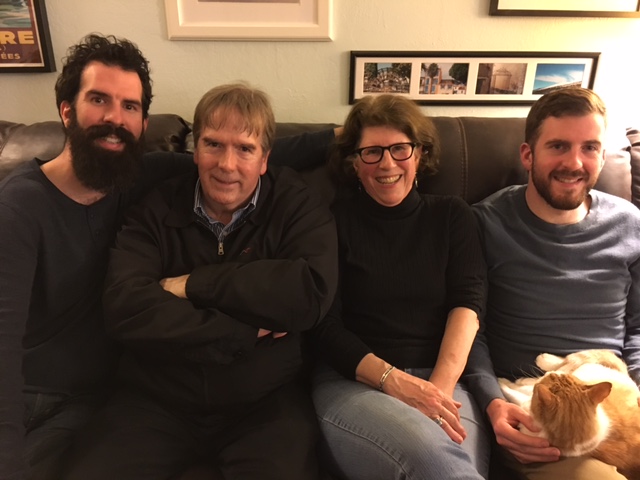 |
| Second son Pat (l), husband Phil, and youngest son Sam (r) |
It's hard to avoid musing on the past and the future. Not in an ordered way, but rather as the musings come to me. I try to avoid the math describing the difference between my current age and the age of my father at his death--96. The likelihood of living beyond him is slim. And the likelihood of living to his age is daunting.
I'm working on a new mantra, though. Maybe "Soak it up." That is, learn all that I can. Feel the colors. Taste the wind. Eat the cheese. Make merry whenever. And weep with abandon.
I have read and re-read a piece written by Roger Cohen in the December New York Times that resonates with me even more fiercely today. He wrote, "Death is the shadow that gives shape to existence, urgency to love, brilliance to life."
This is my plan: Love urgently. Live brilliantly.
Sunday, November 22, 2015
Too Much Information
 Our youngest son, Sam, works at the Sacramento Zoo with animals in the Interpretive Center (IC), which include, generally, animals not able to be on display in the regular part of the Zoo, but many of which are shared with the public through walks around the Zoo or shows in their little theatre. Here's a picture of Sam with the Eclectus and the Thick-Billed Parrot.
He has worked at the Zoo since he was 14, starting as an intern and, when he turned 18, as an employee. After completing his degree, he began working full time. He's been bitten and scratched and wounded in all sorts of ways, but I haven't had real cause to worry about his job in all that time (13 years)--until now.
 Here he is with Bing, the alligator that arrived at the Zoo at about a quarter this size when he was still quite cute. (Some might argue he's still cute.)
And here he is showing my visiting cousin the Armadillo. 

 This little guy is as cute as can be. Awww. But Hedgehog habits aren't so cute. Notice Sam is holding him with a glove (OK, to protect himself from the spines) and a towel. Well, never mind that.
Last night at dinner, our conversation wandered onto the subject of venomous snakes. How we arrived there, I can't remember. But as he explained all about who makes antivenin, how much it costs, how long it lasts, even where it is stored at the Zoo, I said, "You seem to know a lot about the antivenin at the Zoo. There aren't venomous snakes in the IC, are there?" "No," he assured me. "Are there venomous snakes in the Reptile House?" "Yes," he said. "You don't handle those, do you?" "Yes, I do." "But not with your hands?" "No," he said, shaking his head. "Just with snake sticks."
Now I don't have an inordinate fear of snakes. He left his snake in an enclosure in our family room when he moved out. And I don't mind him. He doesn't smell. He doesn't bark. He's boring, but pretty self contained. And since the snake wasn't handled much when he was younger, he will bite, so I don't ever touch him. And anyway, Sam's forced to come home for a visit every so often to feed him. Venomous snakes are in another category. Those I fear.
Now I've watched Sam handle the snake with his snake sticks and I wasn't overly comforted by his suggestion that he doesn't use his hands at the Zoo. When he feeds his snake here at home, he moves him from his enclosure to another container. And that snake has a way of slithering right off those sticks and suddenly, there he is on the floor.
Sometimes mothers can be over-informed.
Sunday, August 9, 2015
iPhone Iconoclast
 |
| Max has pride of place |
 |
| iPhone crack creep |
With each iteration of cell phone comes more technological dependence and today's incident demonstrates my growing reliance on the convenience. I stepped outside this evening to enjoy some time under the elm tree in the breeze and peruse the Michelin green guide to Provence. At least six times I moved my hand automatically to grab the phone (which wasn't there) to look up a word in the dictionaries--both French/English and Webster's, search for more information on something I didn't know about, look up a spot on the map. Pre-phone I had no trouble doing this kind of research without the convenience of the phone by making a note (using an archaic pen) and then consulting the atlas, my maps, the dictionary, even the modern computer. I find myself relegated to the ranks of the young, which could in other circumstances be quite a compliment. But I'm a little ashamed for so heavily relying on something others mock on Facebook, Comedy Central, the late night shows, cartoons, and other media--all available on the iPhone.
 |
| Max in sleep mode |
Saturday, July 25, 2015
Blue
I believe others consider me predictable. I'm not unkind. I know the napkin and fork go to the left of the plate and the knife and spoon to the right--knife on the inside, of course, blade toward the plate. I treat our animals well. I'm usually good for a laugh when the meeting gets tense. I communicate well both verbally and in writing. I'm fussy about my coffee. My drink of choice is gin--unadulterated. I love to eat. I always glance at the river--whatever river that might be--when I pass over a bridge. My friends can count on me in a pinch. I love my family with all my heart.
So now that I've reached the advanced age of over 65 (no need to be specific) having acted mostly responsibly my entire life, I've decided today to go blue. Blue nail polish, that is.
After all, what's the use of maturity if you can't act unpredictably once in a while?
 |
| Add caption |
After all, what's the use of maturity if you can't act unpredictably once in a while?
Friday, July 10, 2015
Le bonheur
From time to time in the last several months, I find myself suddenly overcome with a feeling of "le bonheur" or "happiness." I can't really explain it and I especially can't ever explain the timing of these feelings. I might be walking around the block, which actually is an understandable venue. But it happens just as often when I'm sitting in front of the t.v. watching the news--the bulk of which is stressful, anxiety producing, makes me angry or at least annoyed, fills me with sorrow, and rarely makes me feel good. And sometimes I'm stuck in traffic watching the light turn red and green and red and green while I sit with my foot on the brake. Or in a more understandable moment, I'm at the table with my boys enjoying a meal. It simply strikes uninvited, but most welcome, at the strangest times.
I wonder if I am undergoing some kind of metamorphosis--some physical change in the structure of my brain. Or is it that I've reached a point in my life when I can compartmentalize any frustration or sadness in a way that shuts it down before it can grab my soul. I'm not fighting it. I'm enjoying it. But I cannot really understand it. And I don't remember ever having this kind of intense and sudden feeling out of the blue.
I still ponder morbid thoughts about the endless possibilities that could befall me--especially just as we're ready to leave for France in the fall. But these newfound deep feelings of elation and happiness are a welcome respite. I'm counting on them to comfort me through the drudgery of the already-proving-to-be rancorous presidential campaign, the despair reported about people's lives on the news, the ever-worsening climate change, concern for the ubiquitous terrorist violence, ad infinitum.
I chose "le bonheur" as my companion any time it drifts my way.
I wonder if I am undergoing some kind of metamorphosis--some physical change in the structure of my brain. Or is it that I've reached a point in my life when I can compartmentalize any frustration or sadness in a way that shuts it down before it can grab my soul. I'm not fighting it. I'm enjoying it. But I cannot really understand it. And I don't remember ever having this kind of intense and sudden feeling out of the blue.
I still ponder morbid thoughts about the endless possibilities that could befall me--especially just as we're ready to leave for France in the fall. But these newfound deep feelings of elation and happiness are a welcome respite. I'm counting on them to comfort me through the drudgery of the already-proving-to-be rancorous presidential campaign, the despair reported about people's lives on the news, the ever-worsening climate change, concern for the ubiquitous terrorist violence, ad infinitum.
I chose "le bonheur" as my companion any time it drifts my way.
Sunday, June 21, 2015
Father's Day Commandments
Today is my first Father's Day without a father of my own. It's just one more opportunity for me to conjure up some good memories. And that's easy to do. Recently, I came across Dad's hand-written Ten Commandments and sent them to my siblings. My brother, of course, reminded me of the original fifteen, and Dad would have loved the association with Mel Brooks.
Here are Dad's Ten. And if anyone lived by these, he did. He never passed up an opportunity to sit down with someone whose views he may not have shared prepared to be persuaded--but only if the other point of view somehow worked better for him. And listen he did--always respectfully, I might add.
1. Thou shalt open thine eyes to perceive the "round about."
2. Thou shalt create meaning.
3. Thou shalt care deeply and lovingly for thyself.
4. Thou shalt have care and compassion for all other "thous."
5. Thou shalt learn the rules which enable life to be corporate so that creatures may survive.
6. Thou shalt sing and laugh and take great pleasure.
7. Thou shalt be with others for others without "using" them against their interests.
8. Thou shalt gather together with those who share similar attitudes and meanings to reinforce thine own.
9. Thou shalt gather with others who differ from thee to learn from them.
10. Thou shalt create visions of great good.
Dad was one of a kind. He will always be remembered.
 |
| Dad at Nantes Cathedral, France |
Here are Dad's Ten. And if anyone lived by these, he did. He never passed up an opportunity to sit down with someone whose views he may not have shared prepared to be persuaded--but only if the other point of view somehow worked better for him. And listen he did--always respectfully, I might add.
1. Thou shalt open thine eyes to perceive the "round about."
2. Thou shalt create meaning.
3. Thou shalt care deeply and lovingly for thyself.
4. Thou shalt have care and compassion for all other "thous."
5. Thou shalt learn the rules which enable life to be corporate so that creatures may survive.
6. Thou shalt sing and laugh and take great pleasure.
7. Thou shalt be with others for others without "using" them against their interests.
8. Thou shalt gather together with those who share similar attitudes and meanings to reinforce thine own.
9. Thou shalt gather with others who differ from thee to learn from them.
10. Thou shalt create visions of great good.
Dad was one of a kind. He will always be remembered.
Tuesday, June 16, 2015
Final Days in France
 |
| Dad in Nantes, France, 2008 |
 |
| Four siblings |
 |
| Viaduc de Millau |
Our final day in France we visited Chantilly--on the outskirts of Paris. We have driven by on several occasions and never taken the time to enter. This time we enjoyed the riches of art in the Musee Conde, which is reported to be the second museum of old art (before 1850) in France after the Louvre.
 |
| Staircase ram's head |
 |
| Jeanne d'Arc |
 |
| Chandelier detail |
The Chateau was built in the 16th century and sits on 20 thousand acres of meandering parkland and includes an 18th-century stable for almost 250 horses and many more hunting dogs.
 |
| Hunting dogs statuary |
 |
| View of the stables from the Chateau |
It was on our return drive to the airport before sunrise that we discovered our headlights were frighteningly bad. Traffic on the highway toward Charles de Gaulle was horrendous, so we took an alternate route on back roads where there were blessedly few cars but zero ambient light. We avoided any critters that could easily have been crossing the road in our path unseen and arrived at the car lease company relatively unscathed. After an uneventful flight, it was good to be home.
In the months since our arrival in October, we have already started planning for our next trip in September. Flights have been purchased, the car has been leased, and we have settled on two separate weeks' locations. The remainder of the plans will be on the fly and as the spirit takes us (and the weather is good). When the time comes, I'll post from France again. In the meantime, I'll try to be more communicative.
Saturday, October 11, 2014
Au Revoir, Méditerranée
After spending almost two weeks waking up to the sunrise over the water, we head north for Paris and parts west--far west.
Our host (landlord) arrived exactly on time to check the apartment and was most gracious (and discreet) in checking around at our cleaning job--stellar, I might add. We had spent the early morning cleaning and went for coffee in order to steel ourselves for the day ahead. The lavarie (laundramat) was closed, so I was unable to wash the draps (sheets) and duvet cover, and M. Rigo seemed unfazed by that though his wife may have more to say about it. Right around the corner, we have visited a particular brasserie where we enjoyed either coffee or beer depending on the time of day. We bid adieu to the Madame there, packed the car and carried out the bags of garbage that we Americans accumulate like nobody else.
 |
| From our balcony, sunrise over the Mediterranean |
 |
| Our apartment is just above entrance with green tablecloth |
 |
| Seaside walk in front of our apartment |
After saying goodbye to M. Rigo and leaving him with his keys, we hopped into the car making our feeble attempts at showing energy for the day ahead. We drove north toward Narbonne where the road is often very windy. Fortunately, even the wind generators were still. The last time I drove that stretch, I returned home wracked with pain in my arms and shoulders from clutching the wheel.
The terrain changed from seaside and oyster beds to scrubby hills. North of Narbonne, we headed toward Millau in the Central Massif where the hills changed to mountains and valleys.
Constructed 10 years ago, the bridge at Millau is the highest viaduct in the world. The road bed is 900' above the River Tarn. It's a magnificent feat of engineeering and construction spanning a deep valley in a way that is both practical and graceful. It's a wonder to look at.
The skies opened and we were deluged with rain slowing us down and making the driving more challenging. On the péage (toll road), signs are posted, which show that the normal speed limit is 130 kph. When it's raining, the speed limit reduces to 110 kph, which means the 8.5-hour trip is stretched into a 9-plus-hour trip.
I've described the speed cameras before, so you know we slow down whether we want to or not.
As we moved out of the Massif Central to lower hills again, the woods crept up to the road and the trees became skinny and tall the way they are in northern France (because they are constantly harvested). By the time we passed over the Cher River (which runs through the Loire Valley and, in fact, under my favorite chateau, Chenonceaux), the sky lightened and we saw the sun peek through here and there. After the Cher, the landscape changed to flat long fields far into the distance--a little like the terrain in the agricultural central valley of California. But different. . .
Closer to Paris, traffic became thicker and unpleasant. Already tired, we became resolved to our fate of having to drive the périphérique around Paris at rush hour--in the dark--along with many others not wanting to be there any more than I did. There were no other choices and I found a lane (as far right as possible without being kicked off at whatever the next exit was) where I sat--and I mean "sat," rather than racing smoothly along at my allowed 110 kpm. We finally dumped onto the A6 toward Charles de Gaulle airport and headed for Senlis where we had hotel reservations.
When we finally pulled into the parking lot of the Hotel IBIS, it was past 8 p.m. We had left at 10 a.m. That 8.5-hour drive somehow ballooned to 10 hours. We checked in, dropped our luggage in the room and had dinner at the hotel--not our first choice. But considering our day, that was the best choice.

Glad to be here. Well, sort of glad to be here. . .
 |
| Millau bridge approaching from south |
 |
| Millau bridge from north side |
The skies opened and we were deluged with rain slowing us down and making the driving more challenging. On the péage (toll road), signs are posted, which show that the normal speed limit is 130 kph. When it's raining, the speed limit reduces to 110 kph, which means the 8.5-hour trip is stretched into a 9-plus-hour trip.
 |
| Speed camera ahead |
 |
| Mr. Speed Camera--box in center with evil eyes |
As we moved out of the Massif Central to lower hills again, the woods crept up to the road and the trees became skinny and tall the way they are in northern France (because they are constantly harvested). By the time we passed over the Cher River (which runs through the Loire Valley and, in fact, under my favorite chateau, Chenonceaux), the sky lightened and we saw the sun peek through here and there. After the Cher, the landscape changed to flat long fields far into the distance--a little like the terrain in the agricultural central valley of California. But different. . .
Closer to Paris, traffic became thicker and unpleasant. Already tired, we became resolved to our fate of having to drive the périphérique around Paris at rush hour--in the dark--along with many others not wanting to be there any more than I did. There were no other choices and I found a lane (as far right as possible without being kicked off at whatever the next exit was) where I sat--and I mean "sat," rather than racing smoothly along at my allowed 110 kpm. We finally dumped onto the A6 toward Charles de Gaulle airport and headed for Senlis where we had hotel reservations.
When we finally pulled into the parking lot of the Hotel IBIS, it was past 8 p.m. We had left at 10 a.m. That 8.5-hour drive somehow ballooned to 10 hours. We checked in, dropped our luggage in the room and had dinner at the hotel--not our first choice. But considering our day, that was the best choice.
Glad to be here. Well, sort of glad to be here. . .
Thursday, October 9, 2014
Elne

 |
| Looking over Roman wall into "new" town |
 |
| Narrow houses in old cité |
 |
| Decorative window protection |
 |
| Narrow pedestrianized street |
 |
| Through the wall |
Its monument to the war dead of WW I and the South Asia and Algerian wars is inside the walls overlooking the new town below.
 |
| Maillol sculpture in memoriam to the war dead |
The cathedral is late Romanesque--large for Romanesque. It was the religious center of Roussillon from the 6th to the 17th centuries. When the center changed from Elne to Perpignan, the Bishop up and took the famous relics with him leaving Elne and its cathedral a forgotten backwater.
 |
| Column in cloisters |
 |
| Beautifully-preserved capitals in the cloisters |
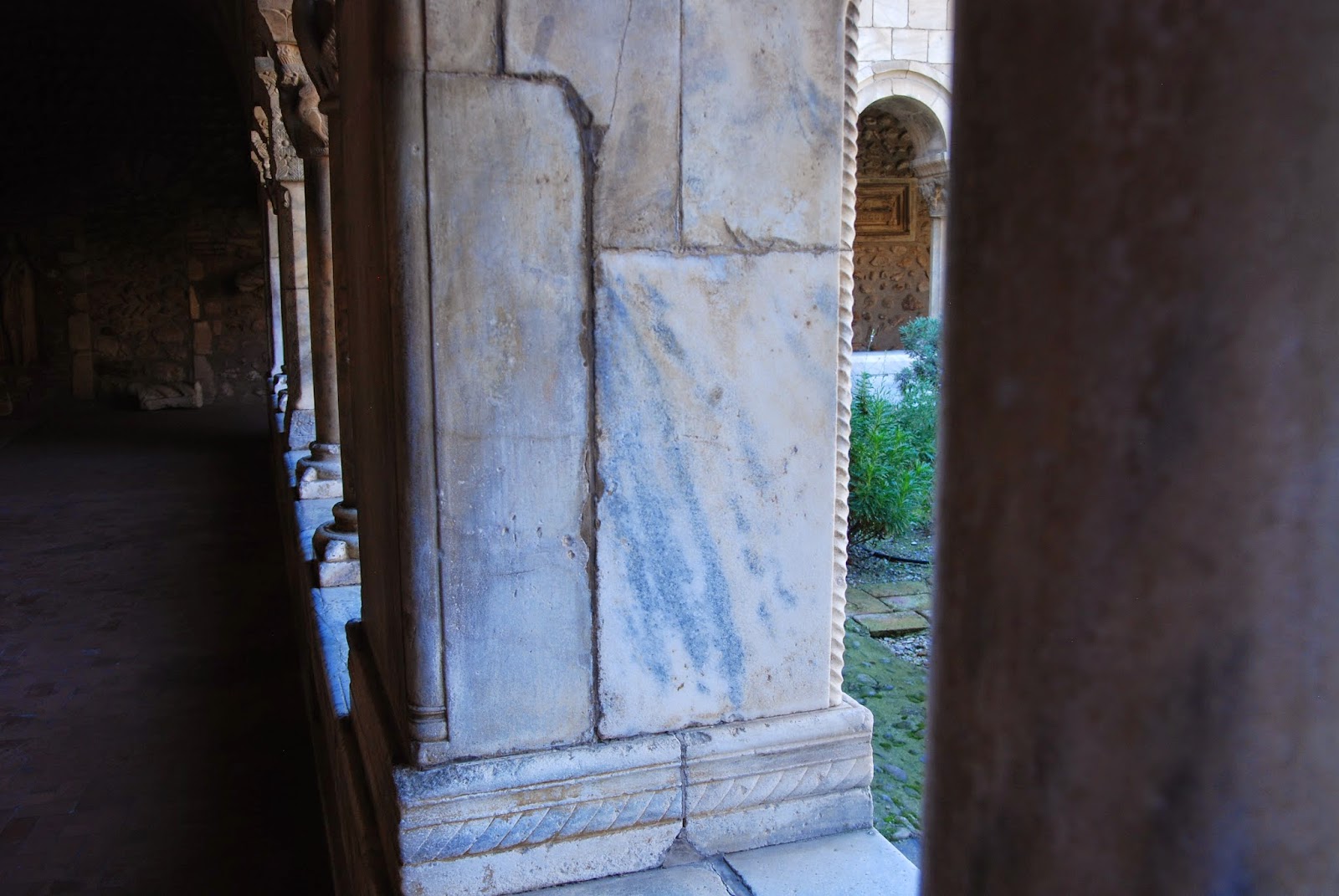 |
| The white blue-veined marble in the cloisters |
Elne is also home to La Maternité Suisse (the maternity hospital) that was made famous by the Swiss nurse, Elizabeth Eidenbenz, who took in at least 1000 women and children between 1939 and 1944. Women fleeing the concentration camps survived the war and gave birth here to 597 children.
A museum dedicated primarily to the work of Etienne Terrus shows their permanent exhibition of his work along with temporary exhibits of other artists. Terrus was friends with Aristide Maillol (from Banyuls-sur-Mer) and Henri Matisse, among others.
Life here in Roussillon holds endless surprises. It's not all beaches and sunshine, though it's also beaches and sunshine. The entire time we've been here, this has been the warmest and sunniest part of France except for Corsica.
Tuesday, October 7, 2014
Cathar Country
Not far from Perpignan in the foothills of the Pyrénées Orientales (eastern Pyrénées) are several Cathar ruins perched on remote mountaintops in remote countryside. The Cathars, a Christian sect, occupied these parts for about 100 years practicing their nonviolent, vegetarian and celibate way of life. They were all the while in a power struggle with the Catholic church in Rome to whose allegiance they did not subscribe. As a result, the Catholic church gave its support to all who would help to rid the area of those they considered to be heretics. In the 14th century, the Inquisition combed through these parts and slaughtered and burned tens of thousands of Cathars.
The remains of the Cathar strongholds are impressive examples of both their ability to create sanctuary in a most inhospitable environment and the tenacity of their enemies to root them out.
We drive first to Força Réal to see l'Ermitage de Força Réal.
Built in 1692 as a place of prayer and introspection, it was left in ruins in 1817 after republican soldiers plundered the place. It was then restored in 1899 and remains today the location for periodic religious celebrations. From the top, one can see to the Vermeille Coast (where we are staying), l'Etang de Salses (northeast of Canet-Plage) and le Canigou in the massif des Albères. At this time of year, there are few other visitors allowing us to have a better sense of the peace of the place. While this is not a Cathar ruin, it is in the Cathar country for which this blog is named.
North from Força Réal lies Quéribus.
Quéribus is the smallest Cathar château and is perched at approximately 728 meters high. It was built between two valleys where the wind is ferocious and would have made its construction conspicuously difficult and dangerous. The château looks out over the Roussillon valley, and we can see both Força Réal and Peyrepertuse, another Cathar château.
When faced with the task of making the climb up to the castle, we opt to commit to the climb at Peyrepertuse as two castles seems formidable.
We move on to Peyrepertuse by snaking back down the mountain through Cucugnan and snaking up another mountain to arrive at the monumental and remarkable château.
From a great distance, the limestone spur is discernible, making it all the more impressive up close. The scale of this castle is oversized. It is at about 800 meters (about 2600') high, 60 meters wide and 300 meters (just under 1000') long. Shaped a little like the Queen Mary, it is a monster.
We buy our tickets, gird our loins and start the climb. Warnings suggest the need for proper footwear (not that I am wearing any) and extra precautions in the wind (for fear of flying over the precipices to certain death). We need more than girded loins for this climb. We also need psychological resolve.
Throwing all caution to the wind (no pun intended), we begin our trek down (yes, down) rocky paths littered with roots and mud and here and there a gnarled trunk of a bushy tree blessedly located within grabbing distance for the needed push. Naturally, we have to go up as well. And up. And up. Mostly climbing on paths that take us both close to the edge and hugging the limestone--the position I prefer.
About half-way there, an English woman passes us going down and cheerily urges us on by saying, "You're almost there." She is lying. There is no "almost" to it. I'm sure her motivation is benevolent. Phil considers it spiteful--likely from years of eating English boiled meat.
Nonetheless, we finally arrive at the chateau itself. On one end of the spur, there are several men doing construction work. One stonemason works by himself in a trench shaping and laying large stones. In other areas in that end, the southeast triangular end, access is denied because of the work. While we are there, we watch a man build a scaffolding out over the end of the chateau with sheer cliff face below. It doesn't seem like something OSHA would have approved.
The donjon and St. Mary's church are in the same general structure, which seems an odd juxtaposition of prison and worship.
At the other end of the spur is the staircase about which we had been warned below, the "Stairs of Saint Louis" giving access to San Jordi's chapel.
The staircase comes with a rope "bannister" to assist all but the most confident climb through the howling wind knowing that the consequences of a misstep could be irreparable and what looks like a newly-constructed railing of wood.
At the top of this staircase are a tower, a window and bench and a fireplace in one room, San Jordi's chapel and a view to what seems like the end of the earth. After Força Réal and Quéribus, I thought the view couldn't get any better; and yet, here at Peyrepertuse, I am speechless.
But then we have to descend the same challenging path on the same inappropriate shoes and the same apparent death wish with which we started the climb in the first place. Phil couldn't help offering his motivational "almost there" to passing climbers. I can only hope those climbers break the chain of that misdirected encouragement.
These ancient sites were built in impossible conditions and geographically remote areas. But the most impressive site in toto is Carcassonne, near Toulouse and the greatest of Europe's walled cities.
Carcassonne sits just above the Aude River, and because of its location between the Mediterranean and the Atlantic was a stopping point on the Romans' journeys from Rome and the Iberian Peninsula to parts northwest. The Romans established the town in the 2nd century B.C. and built the inner walls.
Much later in the 12th century, the town was controlled by Trencavel who built the chateau and the cathedral. He gave sanctuary to the Cathars in 1209; but they were rooted out by the Inquisition in the 14th century. In the 13th century, King Louis IX--the only king to have achieved sainthood, built the outer walls.
Carcassonne was restored to close to its current glory in the 19th century. And glory it is. As one approaches, the walled city looms out of the land like something out of a fairy tale. Heavily touristic, it is nonetheless architecturally and historically fascinating.
The moat is grassy and inviting. The ramparts are complete.
On our first visit here, we stayed at Les Remparts hotel, which is inside the walls. We parked our car on the grass and were allowed to drive in after 6 p.m. when the streets were nearly empty. Then in the morning we had to drive out before 11 a.m. in order to miss the crowds. That was my first experience driving along a street narrow enough that the boys could reach out their arms and touch the walls.
Despite the madness of the crowds, Carcassonne is the frosting on the Cathar cake.
The remains of the Cathar strongholds are impressive examples of both their ability to create sanctuary in a most inhospitable environment and the tenacity of their enemies to root them out.
We drive first to Força Réal to see l'Ermitage de Força Réal.
 |
| View from Forca Real |
 |
| Força Réal with sculpture |
North from Força Réal lies Quéribus.
 |
| Queribus from below |
 |
| View of Peyrepertuse from Queribus |
We move on to Peyrepertuse by snaking back down the mountain through Cucugnan and snaking up another mountain to arrive at the monumental and remarkable château.
 |
| Peyrepertuse from below |
We buy our tickets, gird our loins and start the climb. Warnings suggest the need for proper footwear (not that I am wearing any) and extra precautions in the wind (for fear of flying over the precipices to certain death). We need more than girded loins for this climb. We also need psychological resolve.
 |
| The easy part |
About half-way there, an English woman passes us going down and cheerily urges us on by saying, "You're almost there." She is lying. There is no "almost" to it. I'm sure her motivation is benevolent. Phil considers it spiteful--likely from years of eating English boiled meat.
 |
| We have reached the bottom of the castle. |
 |
| St. Mary's church |
At the other end of the spur is the staircase about which we had been warned below, the "Stairs of Saint Louis" giving access to San Jordi's chapel.
 |
| Looking down the stairs |
 |
| At the top of the stairs |
At the top of this staircase are a tower, a window and bench and a fireplace in one room, San Jordi's chapel and a view to what seems like the end of the earth. After Força Réal and Quéribus, I thought the view couldn't get any better; and yet, here at Peyrepertuse, I am speechless.
 |
| Looking back to the lower part. |
But then we have to descend the same challenging path on the same inappropriate shoes and the same apparent death wish with which we started the climb in the first place. Phil couldn't help offering his motivational "almost there" to passing climbers. I can only hope those climbers break the chain of that misdirected encouragement.
Much later in the 12th century, the town was controlled by Trencavel who built the chateau and the cathedral. He gave sanctuary to the Cathars in 1209; but they were rooted out by the Inquisition in the 14th century. In the 13th century, King Louis IX--the only king to have achieved sainthood, built the outer walls.
Carcassonne was restored to close to its current glory in the 19th century. And glory it is. As one approaches, the walled city looms out of the land like something out of a fairy tale. Heavily touristic, it is nonetheless architecturally and historically fascinating.
 |
| Approach to Carcassonne |
 |
| Outside the walls |
The moat is grassy and inviting. The ramparts are complete.
 |
| Entrance to Carcassonne |
 |
| Between the ramparts and the outer wall |
On our first visit here, we stayed at Les Remparts hotel, which is inside the walls. We parked our car on the grass and were allowed to drive in after 6 p.m. when the streets were nearly empty. Then in the morning we had to drive out before 11 a.m. in order to miss the crowds. That was my first experience driving along a street narrow enough that the boys could reach out their arms and touch the walls.
 |
| Sculpture dedicated to person responsible for restoration |
 |
| Next tour group entering the portal |
Subscribe to:
Posts (Atom)